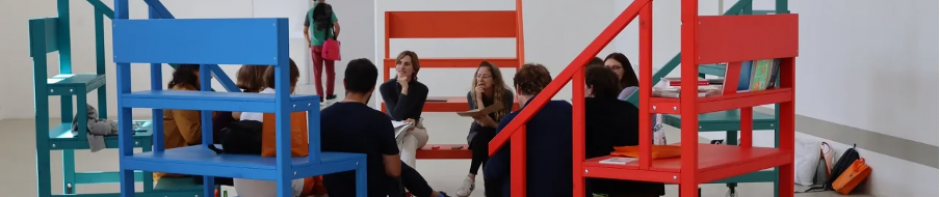
We set out to cover a few NVC fundamentals in the workshop, which was itself an opportunity to scaffold learning for a more in-depth NVC workshop we were holding for the whole course the following day.
Aims:
- Introduce Nonviolent Communication as a concept (Rosenberg 2015);
- Engage participants in an NVC method of listening for feelings and needs;
- Introduce another practice of walking and noticing (Opezzo & Schwarz 2014);
- Allow time for participants to complete the survey, ask questions, and offer verbal feedback.
Sharing the delivery of the session with another facilitator, NVC trainer Ceri Buckmaster, helped me refine the timing of the session, prioritising accessibility (Hamilton and Petty 2023) (hooks 1994) (Oliver 1990), and during delivery, having Ceri there provided me with space to observe as well as support, and lead, which was very helpful with this being my first ARP for which I was quite nervous.
Most students engaged enthusiastically from the outset. An aspect of NVC workshops that myself and colleagues regularly observe, is that as tutors model NVC practices, revealing some personal information, appearing to some extent vulnerable–more fully a human–students respond warmly, meeting this vulnerability with openness. This was the case following the modelling of the needs activity early in the session and set a warm tone.

We were aware that the walking and noticing activity feels quite unnatural at first – you have to really stick to the script and repeat it diligently – so we modeled it through several cycles.
An area for development could be to write more scripts, this could be in collaboration with participants as part of an extended workshop.
Not all participants engaged in the walking and noting activity (something reported honestly in the survey) – some took it as a break, or just walked around college with their partner chatting – all of which fulfilled some of the aims of the exercise.
Scaffolding > Practice
Developing my work from the Inclusive Practices unit, I’d embedded walking practices across several sessions at earlier stages in the unit, beginning with a student-led tour of the LCC building together with a Year 3 guide; then a trip to Tate; and then a video workshop involving strapping cameras to the body and moving around. I’d also introduced references from artist practices that have referenced movement-based interactions with the environment (O’Rourke 2013) (Twemlow and Cardoso (eds.) 2024).
From a previous session I’d facilitated around Agreements and Aspirations, students had some familiarity with talking about feelings and needs – a central concept and practice in NVC.
Information and Consent
I had introduced my ARP to participants verbally in an earlier session; by email together with a Participant Information Sheet; and then in-person on the day of the workshop, along with consent forms.
Time was put aside for participants to complete the survey at the end of the session, and I shared a QR code and a link by email which led to a high response rate (everyone present participated).
The call for a focus group was only taken up by one participant, so I abandoned that element.
Areas for Development
Some observations for areas to look at in future cycles include:
- How to distribute and collect forms – use a box to collect forms so participants don’t feel pressure from research lead – as research lead is also workshop facilitator it’s also possible to see the benefit of going around the group connecting directly with individuals – allow time for students to complete forms
- For the walking and noting activity should we provide a floor plan of LCC to students?; Introduce some coordinates for them to explore?; Name the buildings?; Suggest places?; – for this cycle we asked for students to name some places they like to go and to discuss in their pairs for a few minutes
- Could we integrate a mark-making activity – something around mapping
- How can we measure whether we are supporting students to inhabit ambiguity > building community?
- Different environments will cause different outcomes > how would this activity be if we were outside the whole time? Or at a museum? Another site? (Beames et al. 2012)
Together with my colleagues, former course leader Tara Langford and NVC trainer Ceri Buckmaster, we’ve been exploring ways to adapt NVC methods for a creative education context and to embed aspects of NVC in the curriculum. This felt like another sustainable step in that process.
References
Beames, S., Higgins, P. and Nicol, R. (2012) Learning outside the classroom: Theory and guidelines for practice. London and New York: Routledge.
Hamilton, L.G. and Petty, S. (2023) ‘Compassionate pedagogy for neurodiversity in higher education: A conceptual analysis’, Frontiers in Psychology, 14. https://doi.org/10.3389/fpsyg.2023.1093290
hooks, b. (1994) Teaching to Transgress: Education as the Practice of Freedom. Routledge, London.
meenadchi (2021) Decolonizing Non-Violent Communication. 3rd ed. Los Angeles: Feminist Center for Creative Work
Oliver, M. (1990) The Politics of Disablement. Basingstoke: Macmillan.
Oppezzo, M., & Schwartz, D. L. (2014). Give your ideas some legs: The positive effect of walking on creative thinking. Journal of Experimental Psychology: Learning, Memory, and Cognition, 40(4), 1142–1152. https://doi.org/10.1037/a0036577
O’Rourke, K. (2013) Walking and mapping: Artists as cartographers. Cambridge, MA: MIT Press.
Orr, S and Shreeve, A. (2017) Art and Design Pedagogy in Higher Education: Knowledge, Values and Ambiguity in the Creative Curriculum. London: Routledge.Waerea, K. (2024) Access questions for self-publishing: A resource. London: Pagemasters.
Opezzo, M. and Schwartz, D.L. (2014) Give Your Ideas Some Legs: The Positive Effect of Walking on Creative Thinking, Journal of Experimental Psychology: Learning, Memory, and Cognition Vol 40, No 4, 1142-1152
Rosenberg, M. B. (2015) Nonviolent communication: A language of life (3rd ed.). PuddleDancer Press.