Walk Gum and Chew at the Same Time
The aim of the project is to gain insights into BA Design for Art Direction (DfAD) student experience of using Nonviolent Communication (NVC) methods in the classroom setting and outside the classroom setting, so that we can better understand the impact of these activities and the environments in which they’re undertaken and review their use for future workshops.
Coming out of my intervention for the Inclusive Practices unit, and building on the work with Nonviolent Communication that myself and colleagues have been developing on the BA Design for Art Direction course at LCC over the past 5 years, my action research project (ARP) explores combining walking practices and Nonviolent Communication (NVC) methods.
Informed by Orr and Shreeve’s observations around the importance of inhabiting ambiguity in creative education (Orr and Shreeve 2017), and a Stanford study on the positive impact of walking on creative thinking (Opezzo & Schwarz 2014), I’ve focussed on embodied and relational approaches (Ahmed 2006), exploring ways in which environmental interventions such as introducing more activities outside of the studio space can meet a range of student needs providing opportunities for connection, curiosity, observation and reflection.
From my own positionality as neurodiverse and through observing the challenges neurodiverse students experience, my research considers methods for compassionate pedagogy for neurodiversity (Hamilton and Petty 2023) and outdoor learning (Beames, Higgins and Nicol 2012), exploring ways environmental interventions such as introducing more activities outside the studio can meet student needs, providing opportunities for connection, curiosity, observation and reflection.
Prioritising both student and staff wellbeing has become an important aspect of my teaching and learning approach, and I’ve found methods from NVC to effectively support this. Various activities such as role-plays; workshops; and mindfulness exercises, which can be practiced with participants to apply the principles of NVC to a range of situations–many of which, such as collaboration and group work, and offering and receiving critical feedback–are relevant in an art and design education context.
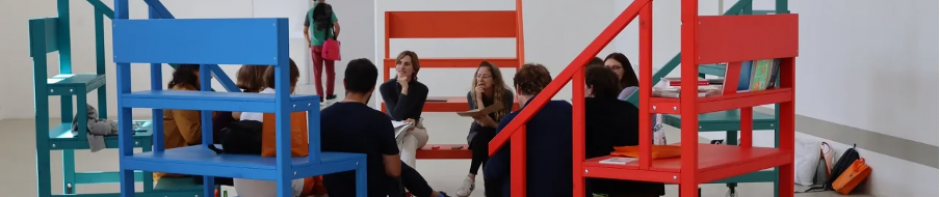
For my ARP I developed a workshop that introduces NVC practices to year 1 BA Design for Art Direction students in their first semester. I co-facilitated a workshop with NVC trainer Ceri Buckmaster with the goal of supporting connection and community. Students are introduced to NVC methods including the four-step model of Observation, Feelings, Needs, Request, that much of NVC practice hinges on (Rosenberg 1999). With the aim of familiarising participants with their environment at the same time as practicing methods for observation, I introduced a walking practice where participants move through the college whilst engaging in an NVC activity of observing and noting.
My research also draws on Decolonizing Non-Violent Communication (meenadchi 2019) and overlapping practices including those of Augusto Boal (Boal 1992), the writing of bell hooks (hooks 1994, 2003, 2010) and Paulo Freire (Freire 1968); as well as theoretical texts by Sara Ahmed (Ahmed 2006, 2017, 2019), Edouard Glissant (Glissant 1997), and Aruna D’Souza (D’Souza 2024).
It’s important to acknowledge critiques and limits of NVC, especially in relation to those who are routinely subjected to the extractivism of colonialism, racism, ableism, and sexism.
Aruna D’Souza says: “The refusal of a politics that relies on empathy to build solidarity is, for people of the global majority especially, a matter of self-preservation.”
Drawing on Edouard Glissant’s Poetics of Relation, she states: “The right to opacity stands in opposition to Western ontology’s demand for transparency–a demand to know the other (whether an individual or a culture or, in fact, however otherness is being conceptualized in the moment). The West’s need to know is never innocent curiosity, and rarely is it a simple desire for entanglement—it almost always takes place within a relationship of domination, and thus whatever knowledge results is essentially derived without real consent.” (D’Souza 2024)
The community building workshops were scaffolded with visits to local cultural venues as well as practical workshops that include movement and which centre creative and experimental approaches and techniques (Le Guin, U.K. 1989) (O’Rourke, K. 2013) (Sutcliffe, J. 2017) (Twemlow, A. and Cardoso, T.A. (eds.) 2024).
My research takes a mixed method qualitative approach combining data collection via a survey (Converse, J M. and Presser, S. 2011); a focus group; observations from a workshop (Jones, L., Holmes, R., MacRae, C. and MacLure, M. 2010); and interviews with colleagues (Silverman, D. 1997).
At the same time as bringing methods and occasion for community connection to student participants, and activities which support both student and staff wellbeing, the workshops provided another opportunity for myself and my colleague Ceri Buckmaster to adapt NVC practices to the more specific needs presented in a creative education environment.
References
Ahmed, S. (2006) Queer phenomenology: Orientations, objects, others. Durham and London: Duke University Press.
Ahmed, S. (2017) Living a feminist life. Durham and London: Duke University Press.
Ahmed, S. (2019) What’s the use? On the uses of use. Durham and London: Duke University Press.
Beames, S., Higgins, P. and Nicol, R. (2012) Learning outside the classroom: Theory and guidelines for practice. London and New York: Routledge.
Boal, A. (1992) Games for actors and non-actors. London: Routledge.
Converse, J M. and Presser, S. (2011) ‘The Tools at Hand’ in Survey Questions. SAGE Publications DOI: https://dx.doi.org/10.4135/9781412986045
D’Souza, A. (2024) Imperfect solidarities. Berlin: Floating Opera Press.
Freire, P. (2017) Pedagogy of the oppressed. London: Penguin Classics.
Glissant, E. (1997) Poetics of Relation. University of Michigan.
Hamilton, L.G. and Petty, S. (2023) ‘Compassionate pedagogy for neurodiversity in higher education: A conceptual analysis’, Frontiers in Psychology, 14. https://doi.org/10.3389/fpsyg.2023.1093290
hooks, b. (1994) Teaching to transgress: Education as the practice of freedom. New York and London: Routledge.
hooks, b. (2003) Teaching community: A pedagogy of hope. New York and London: Routledge.
hooks, b. (2010) Teaching critical thinking: Practical wisdom. New York and London: Routledge.
Jones, L., Holmes, R., MacRae, C. and MacLure, M. (2010) ‘Documenting classroom life: How can I write about what I am seeing?’, Qualitative Research, 10(4), pp. 479–491. https://doi.org/10.1177/1468794110366814
Le Guin, U.K. (1989) Dancing on the edge of the world. New York: Grove Press.
meenadchi (2019) Decolonizing non-violent communication. Los Angeles: Co-Conspirator Press.
O’Rourke, K. (2013) Walking and mapping: Artists as cartographers. Cambridge, MA: MIT Press.
Orr, S and Shreeve, A. (2017) Art and Design Pedagogy in Higher Education: Knowledge, Values and Ambiguity in the Creative Curriculum. London: Routledge.
Oppezzo, M. and Schwartz, D.L. (2014) ‘Give your ideas some legs: The positive effect of walking on creative thinking’, Journal of Experimental Psychology: Learning, Memory, and Cognition, 40(4), pp. 1142–1152. https://doi.org/10.1037/a0036577
Rosenberg, M.B. (2015) Nonviolent communication: A language of life. 3rd edn. Encinitas, CA: PuddleDancer Press.
Silverman, D. (1997) ‘Views on interviews: A skeptical review’, in Silverman, D. (ed.) Interpreting qualitative data: Methods for analysing talk, text and interaction. London: Sage, pp. 91–109. https://doi.org/10.4135/9781446268353.n2
Sutcliffe, J. (2017) ‘What do you want Michael?’, in Crowe, M. An attempt at exhausting a place in GTA Online. London: Studio Operative.Twemlow, A. and Cardoso, T.A. (eds.) (2024) Walking as research practice. Amsterdam: Roma Publications.